Virginia Truck Accident Attorney
Click on the link below to connect with our legal team for a free consultation, we’ll respond within 1 hour during business hours. Or call us 24/7 at (757) 244-7000.
Serious truck crashes demand serious representation. Call us today at (757) 244-7000 so we can start protecting your rights and your future.



.png)

A crash with a commercial truck can change your life in seconds. When an 80,000-pound vehicle collides with a passenger car, the people inside the smaller vehicle can suffer devastating injuries.
In the days afterward, you may know very little about the truck that hit you. The driver's name may be on the police report, but that does not necessarily tell you who owned the tractor, who owned the trailer, who employed the driver, or whose cargo was being hauled.
Those details can become important when determining why the crash happened and who is responsible.
Smith Law Center has represented injured people since 1949, including Virginians with traumatic brain injuries, spinal cord injuries, and other catastrophic injuries. Our attorneys know how to investigate commercial truck crashes and pursue records held by trucking companies and other businesses involved in getting a truck onto the road.
If you or someone you love was seriously injured, contact a Virginia truck accident lawyer at Smith Law Center online or call (757) 244-7000 for a free consultation.
“Everyday is spent preparing for your case. Your goals become my mission.”

Types of Truck Accidents Our Virginia Truck Crash Lawyers Handle
When a large commercial truck, like an 18-wheeler, is involved in a crash, the results are often horrific. The size and weight of these vehicles can make certain types of collisions especially dangerous for the people traveling beside them.
Smith Law Center handles Virginia truck crashes involving:
- Jackknife accidents: The trailer swings outward toward surrounding lanes of traffic, potentially striking several vehicles.
- Rollover accidents: A truck can roll after taking a curve too quickly, losing control, or experiencing a shift in improperly loaded cargo.
- Underride and override accidents: A passenger vehicle can become trapped beneath a trailer or be run over by a much larger truck.
- T-bone or side-impact accidents: A commercial truck strikes the side of another vehicle, where occupants have far less protection from the impact.
- Rear-end accidents: A tractor-trailer may be unable to stop before reaching slower or stopped traffic ahead.
- Blind spot accidents: A car traveling alongside a truck can disappear from the driver's view before a lane change.
- Wide-turn accidents: A truck can cross into another lane or strike a vehicle while making a turn that requires additional space.
Truck crashes also involve far more than 18-wheelers. Virginia roads carry fuel tankers, dump trucks, cement mixers, refrigerated trailers, moving trucks, tow trucks, construction vehicles, and other commercial vehicles.
The type of truck matters because it can change what needs to be investigated. A tanker crash can raise questions about hazardous materials. A dump truck rollover may require examination of how the vehicle was loaded. A tractor-trailer collision can involve separate companies responsible for the driver, tractor, trailer, and cargo.
A Survivor’s Story: Finding Support After a Truck Accident
Before the crash, Nancy's days were full of restoring historic pieces, volunteering, and staying connected to her community. The accident shattered that routine. Here, she talks openly about what she went through and how Smith Law Center helped her rebuild her life.
Virginia Truck Accident Statistics You Should Know
According to the Virginia DMV, 3,078 crashes involving large trucks occurred in Virginia in 2024. Those crashes included:
- 48 fatal crashes
- 874 injury crashes
- 2,156 property-damage crashes
The numbers provide a statewide picture, but they cannot show what happens inside a family after a catastrophic collision. A person who survives may spend weeks in a hospital, need months of rehabilitation, or discover that an injury will permanently affect how they work and live.
Injuries a Virginia Truck Crash Lawyer Can Help You With
Smith Law Center is nationally recognized for its work involving serious and catastrophic injuries. Our attorneys have represented clients injured in Virginia semi-truck accidents with:
- Traumatic brain injuries (TBIs);
- Spinal cord injuries and paralysis;
- Severe fractures and orthopedic injuries;
- Internal organ damage and internal bleeding;
- Whiplash;
- Burns and disfigurement; and
- Emotional trauma and PTSD.
A traumatic brain injury deserves particular attention after a truck crash because the full extent of the injury may take time to become clear.
Someone can survive the initial collision and later struggle with memory, concentration, balance, headaches, personality changes, fatigue, or the ability to return to work. Family members are often among the first to recognize that the person who came home from the hospital is behaving differently.
Smith Law Center Partner David Holt discussed these injuries in Episode 11 of the Cases 4 Causes podcast, Traumatic Brain Injuries with David Holt. The episode explores traumatic brain injury litigation and the challenges involved in representing people whose injuries can affect nearly every part of their lives.
For a person with a serious TBI, the case may eventually need to account for rehabilitation, future medical care, lost earning ability, help with daily activities, and other needs that were impossible to predict during the first few days after the collision.
Listen to the Episode
After a Virginia Truck Accident, These Details Can Become Important
If you were taken from the crash scene by ambulance, do not worry that you failed to photograph the truck, get the driver's information, or collect evidence. A serious injury takes priority, and much of the information needed to investigate the crash can be obtained afterward.
There are, however, details worth saving if you or a family member already has them.
Do you have a photo showing the side of the truck?
Keep it. The company name and USDOT number displayed on the cab can help identify the motor carrier. If the tractor and trailer have different names or identifying numbers, keep photographs of both.
Did you notice anything unusual before the collision?
Write down what you remember. Maybe the truck had been drifting between lanes. You saw it approaching quickly as traffic ahead had stopped. A tire blew immediately before the truck lost control. Cargo fell from the trailer. You smelled brakes or saw smoke.
Details like these can give your Virginia truck accident lawyer a place to start when investigating driver fatigue, mechanical problems, unsecured cargo, excessive speed, or another cause.
Were you near a business, warehouse, toll facility, or intersection?
Tell your Virginia truck accident attorney. Cameras on commercial properties, nearby vehicles, or traffic infrastructure may have recorded the truck before or during the collision. That footage may only be retained for a limited period.
Did the trucking company's insurer contact you?
Keep the email, letter, voicemail, or text. You may also be asked to give a recorded statement.
You do not have to reconstruct a violent collision from memory for another company's insurer while you are injured, taking medication, or still trying to understand what happened. Speak with your Virginia truck accident attorney before agreeing to a recorded interview.
Do you remember anything the truck driver said or did afterward?
Write it down. Statements made at the scene, signs that the driver appeared extremely tired or impaired, or comments about the truck itself could become relevant later.
Then there is evidence you probably cannot collect yourself.
Depending on the vehicle and circumstances, Smith Law Center may seek:
- Electronic logging device records showing the driver's hours;
- Dispatch messages and trip information;
- Onboard or event data;
- Dashcam footage;
- Driver qualification and training records;
- Inspection and maintenance records;
- Drug and alcohol testing information when applicable;
- Bills of lading and cargo records; and
- Records identifying the companies responsible for the tractor, trailer, cargo, or driver.
If you are hospitalized or caring for a family member who was seriously injured, you do not need to become the investigator. Smith Law Center can work on identifying the truck, the companies involved, and the records that need to be preserved while your attention remains with your family and medical care.
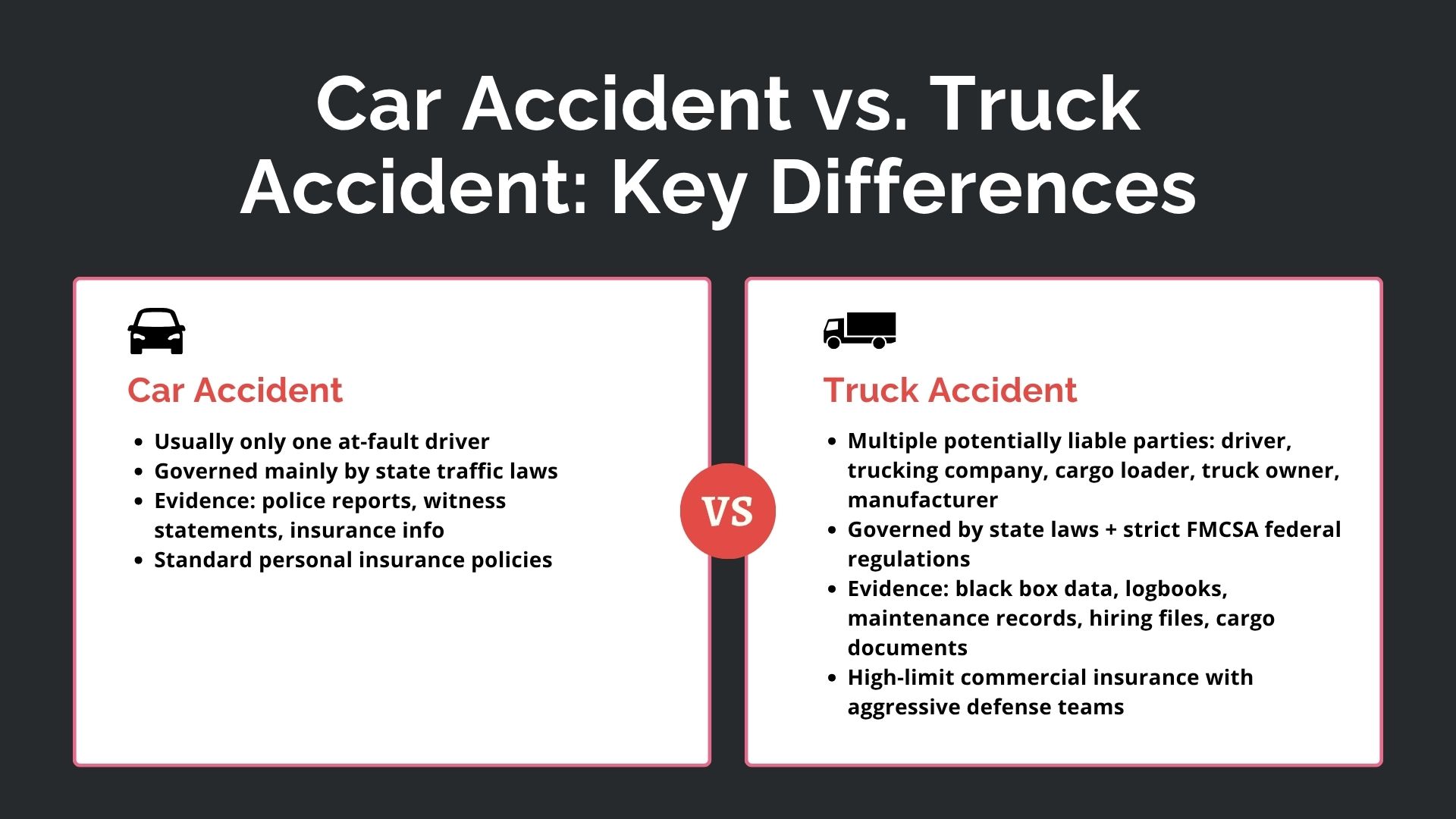
Why a Truck Crash Can Involve Several Companies
After a passenger-car accident, identifying the other driver and their insurance company is usually fairly straightforward. A commercial truck can be different.
The logo on the door may identify one business. The trailer may belong to another. The driver could work for a motor carrier hauling freight owned by a separate company. Another business may have loaded the trailer, while an outside company handled maintenance.
That matters when a mechanical problem, cargo issue, or company decision contributed to the collision.
Depending on what the investigation finds, responsibility could involve:
- The truck driver;
- The motor carrier or trucking company;
- The owner of the tractor or trailer;
- A company responsible for loading or securing cargo;
- A maintenance or repair company; or
- A manufacturer of defective truck equipment.
Suppose a tractor-trailer rolls over on a Virginia interstate because its cargo shifted. The investigation should go further than asking whether the driver was traveling too fast. Who loaded the trailer? How was the freight secured? Was the load properly balanced? Did the driver inspect it before leaving? Who was responsible for checking it during the trip?
Contracts, bills of lading, maintenance records, shipping documents, driver records, and company communications can help answer those questions.
That is why identifying the truck driver can be only the beginning of a commercial truck accident investigation.
What Federal Trucking Rules Can Tell Us About a Crash
Federal Motor Carrier Safety Administration (FMCSA) regulations govern many aspects of commercial trucking, including how long drivers can remain behind the wheel, vehicle inspections and maintenance, driver qualifications, and cargo securement.
After a crash, those rules can help answer much more specific questions.
Had the driver been on the road too long?
Electronic logging device records can show driving and on-duty time. Dispatch records, fuel purchases, toll records, and other information can also help reconstruct the driver's trip when fatigue is suspected.
Did the company know the truck had a problem?
Drivers and motor carriers have inspection and maintenance responsibilities. If brakes, tires, lights, or another component failed, maintenance records can show previous repairs, inspections, and reported defects.
Was the driver qualified to operate that truck?
Driver qualification records can contain information about licensing, medical qualifications, driving history, and other requirements.
Was the cargo properly secured?
Federal rules address how cargo must be secured during transportation. Those records can be especially important after a rollover, jackknife, lost-load accident, or crash involving cargo that shifted inside a trailer.
Were drugs or alcohol involved?
Commercial drivers covered by federal regulations are subject to drug and alcohol testing requirements, including testing under certain circumstances following a crash.
A violation does not automatically explain why a collision happened. It can, however, reveal a safety problem that deserves further investigation.
For example, a tractor-trailer's brakes might fail while descending a grade on I-81. The question then becomes whether the failure was sudden and unforeseeable or whether inspection and maintenance records show a problem that existed before the truck began that trip.
Dangerous Virginia Trucking Corridors
Truck traffic is part of everyday driving throughout Virginia, but several highways place particularly heavy commercial traffic alongside commuters, families, and tourists.
I-81 through western Virginia
Interstate 81 is one of Virginia's major freight routes, carrying commercial traffic through the Shenandoah Valley and western part of the state.
Drivers share the highway with tractor-trailers through long stretches of mountainous terrain, grades, curves, construction areas, and places where traffic can slow quickly. A truck traveling too fast for conditions or following too closely may have little room to respond when vehicles ahead suddenly brake.
Crashes along I-81 can occur near communities such as Bristol, Wytheville, Roanoke, Lexington, Staunton, Harrisonburg, and Winchester.
I-95 through Richmond, Fredericksburg, and Northern Virginia
Anyone who regularly drives I-95 in Virginia knows how quickly traffic can change from highway speeds to a backup.
That is particularly significant for tractor-trailers because their size and weight affect stopping distance. Congestion around Richmond, Fredericksburg, and Northern Virginia puts commercial trucks into traffic where abrupt slowdowns and lane changes are common.
I-64 between Hampton Roads and Richmond
I-64 carries commercial traffic through Hampton Roads, including trucks moving freight to and from the Port of Virginia, and continues through Williamsburg toward Richmond before extending west across the state.
For Smith Law Center, headquartered in Hampton, this is familiar territory. Truck traffic mixes with daily commuters and seasonal traffic through Newport News, Hampton, Norfolk, Chesapeake, Virginia Beach, and the surrounding region.
I-66 and I-77
I-66 carries commercial vehicles alongside dense commuter traffic in Northern Virginia. I-77 serves an important north-south freight route through southwest Virginia and includes mountainous stretches that can present additional challenges for heavy trucks.
The interstate itself is only one piece of a crash investigation. Weather, construction, grades, curves, congestion, visibility, and where the truck was traveling before the collision can all provide context for what happened.
Damages After a Virginia Truck Accident
For someone with a broken arm who returns to work after several weeks, calculating financial losses may be relatively straightforward.
A catastrophic truck injury can be very different.
Consider someone who suffers a spinal cord injury and can no longer walk. The financial consequences could include rehabilitation, a wheelchair, replacement equipment over time, modifications to a home or vehicle, help with daily activities, lost income, and decades of medical care.
A serious brain injury can create different needs. A person may physically recover enough to leave the hospital but struggle with memory, judgment, communication, concentration, or behavior. Returning to the same career may no longer be possible.
Depending on the case, compensation can address:
- Emergency treatment and hospitalization;
- Surgery and rehabilitation;
- Future medical care;
- Medication and medical equipment;
- Lost wages;
- Reduced future earning capacity;
- Property damage;
- Physical pain;
- Permanent disability or disfigurement; and
- Other effects the injuries have on the person's life.
When a Virginia truck crash is fatal, eligible family members can pursue a wrongful death claim. The damages available are governed by Virginia's wrongful death law and can include losses associated with income, services, companionship, medical expenses, and funeral expenses.
When a truck crash has caused a catastrophic injury, the value of the case cannot be measured by the medical bills already sitting on the kitchen table. Smith Law Center can work with medical and other experts to evaluate the care, assistance, and financial losses the injury is expected to create in the years ahead. Call (757) 244-7000 for a free consultation.
Most Common Causes of Truck Accidents in Virginia
A police report might say that a truck was speeding, changed lanes improperly, or rear-ended another vehicle. A full investigation can go further and determine why that happened.
Common causes include:
- Driver fatigue: A driver may have exceeded allowable driving hours, slept poorly during required rest periods, or been working an irregular schedule.
- Distracted driving: Phones, navigation systems, dispatch communications, food, and other distractions can take a driver's attention from the road.
- Speeding or driving too fast for conditions: A speed that might appear reasonable on an open interstate can become dangerous when traffic backs up, rain reduces traction, or a truck begins descending a grade.
- Unsafe lane changes: Tractor-trailers have substantial blind spots, making proper mirror checks and awareness of surrounding vehicles particularly important.
- Following too closely: Heavy trucks require more stopping distance, which can become critical when Virginia interstate traffic slows abruptly.
- Poor maintenance: Brake, tire, steering, lighting, and other mechanical problems can contribute to loss of control.
- Improper cargo loading: Freight that shifts or is inadequately secured can affect the truck's balance or fall onto the roadway.
- Impaired driving: Alcohol, illegal drugs, and impairing medications can affect a commercial driver's ability to safely operate the vehicle.
Virginia DMV's 2024 data provides additional context. Improper lane changes were attributed to 464 truck drivers involved in crashes, while 215 were cited for following too closely and 80 for speeding.
In a serious case, Smith Law Center can compare what happened on the road with electronic records, company documents, vehicle evidence, and the applicable safety requirements to determine what led to the collision.
Virginia Laws That Can Decide a Truck Accident Case
Two Virginia rules deserve particular attention after a commercial truck collision.
Virginia's contributory negligence rule
Virginia follows contributory negligence, which can bar an injured person from recovering damages if that person is found legally responsible for contributing to the accident.
That makes seemingly small details important.
A trucking company may argue that you were driving in the truck's blind spot, changed lanes immediately before impact, followed too closely, or failed to react quickly enough. Those allegations can become a major part of the case because of Virginia's rule.
You do not have to accept an insurer's version of the collision simply because it places part of the blame on you. Dashcam footage, vehicle data, witnesses, roadway evidence, photographs, and accident reconstruction can provide a more complete account.
Virginia's filing deadline
Virginia generally gives an injured person two years from the date of an accident to file a personal injury lawsuit.
There are circumstances in which different rules or deadlines apply. Claims involving government vehicles, for example, can carry additional notice requirements.
The two-year deadline also should not be confused with how long evidence remains available. A video recording or piece of electronic trucking data can disappear well before the statute of limitations expires.
What Does Smith Law Center Look for When Investigating a Truck Crash?
The investigation should follow the facts of the collision rather than the same checklist in every case.
If a truck rear-ended stopped traffic, attorneys may focus on speed, braking, following distance, driver distraction, and hours behind the wheel.
If a tire separated at highway speed, the investigation can turn toward inspection records, tire age and condition, maintenance, and prior reports of problems.
If a trailer rolled over, cargo weight and securement, speed, steering inputs, and how the load was distributed can become important.
Smith Law Center can seek evidence such as:
- Electronic logging device records;
- Event and onboard vehicle data;
- Dashcam and surveillance footage;
- Driver qualification files;
- Dispatch records and communications;
- Inspection and maintenance records;
- Cargo and shipping documents;
- Drug and alcohol testing records when relevant;
- Company safety records; and
- Witness testimony.
Experts may also inspect the vehicles, analyze roadway evidence, reconstruct the collision, or evaluate mechanical failures.
Our firm's role extends to the injury side of the case as well. In a catastrophic injury claim, medical specialists, vocational experts, economists, life-care planners, and other professionals may be needed to explain how the crash will affect the injured person's future.
A Martindale-Nolo survey of personal injury claimants found that more than nine out of ten people represented by an attorney received a settlement or award, compared with about half of those who handled their claims themselves. The survey covered personal injury claims generally and does not predict the outcome of an individual truck accident case.
Serving Truck Accident Victims Across Virginia
Smith Law Center is based in Hampton and represents people injured in commercial truck crashes throughout Virginia.
Our attorneys handle cases arising from crashes in Hampton Roads and elsewhere across the Commonwealth, including collisions in and around:
- Hampton;
- Richmond;
- Newport News;
- Fredericksburg;
- Norfolk;
- Roanoke;
- Virginia Beach;
- Chesapeake;
- Northern Virginia; and
- Communities throughout the I-81 corridor.
Having a statewide practice is particularly useful in trucking litigation because the carrier involved in a Virginia crash may be headquartered hundreds of miles away. The driver, trucking company, trailer owner, shipper, maintenance provider, and insurer can all be located in different states.
Why Hire a Virginia Big Rig Accident Attorney at Smith Law Center?
Smith Law Center has represented injured people since 1949 and has recovered more than $1 billion for clients across its personal injury practice.
That experience includes serious truck accident and catastrophic injury litigation. Our results include a $10 million jury award for a woman who suffered a serious head injury in a truck accident, as well as its nationally recognized work in traumatic brain injury cases.
A truck case can require the resources to obtain corporate records, hire appropriate experts, reconstruct a collision, document lifelong medical needs, and take the case to a jury when a fair resolution cannot be reached.
If you or someone you love was seriously injured in a commercial truck crash, contact Smith Law Center online or call (757) 244-7000 for a free consultation with a Virginia tractor trailer accident lawyer.




FAQs
When should I file my Virginia truck accident lawsuit?
Virginia generally gives you two years from the date of the accident to file a personal injury lawsuit. Certain cases can involve different requirements or deadlines, so it is worth having the deadline confirmed based on your circumstances.
What is my Virginia truck accident lawsuit worth?
There is no standard value. A serious truck accident claim can account for medical treatment, future care, lost income, reduced earning ability, permanent injuries, and how the crash has affected your daily life.
How much will it cost to hire a Virginia 18-wheeler accident lawyer?
Smith Law Center handles these cases on a contingency fee basis. You do not pay an upfront attorney fee, and the firm's attorney fee is paid from a recovery if your case is successful.
Can a Virginia trucking accident lawyer still help me if I am partially at fault for the accident?
Yes. This is particularly important in Virginia because of the state's contributory negligence rule. An insurer's allegation that you contributed to the crash can have serious consequences, making an independent investigation of the evidence important.
What happens if my truck accident case goes to trial?
Going to trial means a judge or jury will hear evidence about the collision, responsibility for it, your injuries, and the damages you are seeking.
Before that happens, the attorneys can take depositions, obtain company records, question witnesses, and work with experts. You will also be prepared for your own testimony so you know what to expect before entering the courtroom.
Smith Law Center has extensive trial experience and prepares serious injury cases with the possibility that a jury may ultimately need to decide the dispute.
Truck Accident Verdicts & Settlements
Williamsburg Woman Awarded $2,900,000.00 in Tractor-Trailer Accident for Mild Head Injury
Awarded:
Summary:
Cyclist Struck by Passing Truck’s Side Mirror Awarded for Mild Head Injury
Awarded:
Summary:
About Smith Law Center