Can You Trust AI for Personal Injury Legal Advice?
Can You Trust AI for Personal Injury Legal Advice?
.avif)
.webp)
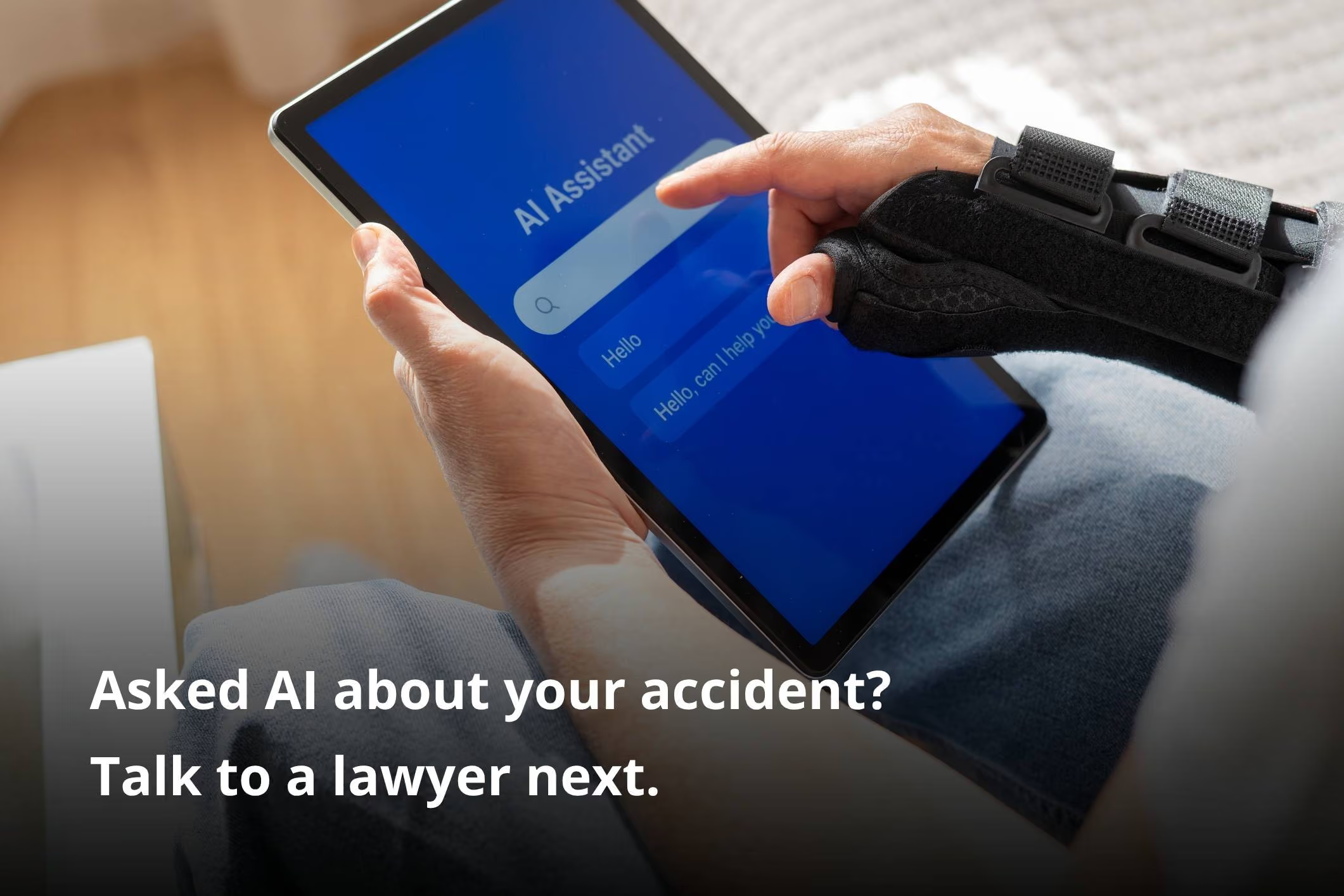
After an accident, getting an answer to a legal question can take seconds. Open ChatGPT or another AI tool, describe what happened, and ask: Do I have a case? How much could my claim be worth? Was I partly at fault? How long do I have to sue?
People are already doing it. The American Bar Association reports that 13% of surveyed legal consumers have used an AI tool or chatbot to research legal issues.
AI can be a useful place to begin your research. The trouble comes when an answer that sounds authoritative is treated like legal advice tailored to your case.
Smith Law Center has represented injured people since 1949 and handles serious personal injury cases involving car and truck accidents, traumatic brain injuries, spinal cord injuries, medical malpractice, defective products, and wrongful death. If an AI answer has left you wondering what actually applies to your situation, call (757) 244-7000 for a free consultation.
What Is AI Good at When You’re Researching an Injury?
You do not need to avoid AI altogether. There are several ways it can be helpful when you are trying to make sense of unfamiliar medical or legal information.
You might use it to:
- Explain an unfamiliar legal term you came across while researching your claim;
- Break down complicated language in information you are reading;
- Help organize a timeline of what happened before and after your injury;
- Develop questions you want to ask an attorney; or
- Identify topics you want to research through reliable sources.
Those uses give you information to work with. They do not require AI to decide whether someone was legally negligent, how Virginia law applies to your circumstances, or what compensation you could recover.
There is another reason to be careful about what you type into an AI tool. Avoid including information you would not want disclosed later, such as detailed conversations with your attorney, litigation strategy, or sensitive facts about your case. Depending on the tool and its settings, what you enter may be stored or used in ways you did not expect.
What Happens When AI Gives You the Wrong Legal Information?
AI can produce an answer that reads as though it came from a reliable legal source even when parts of it are inaccurate.
Researchers at Stanford Law School tested AI-powered legal research products from LexisNexis and Thomson Reuters and found that even these specialized systems hallucinated more than 17% of the time.
For an injured person, bad information could involve something as significant as:
- The deadline for filing a lawsuit;
- The law used to determine who was at fault;
- The types of compensation available;
- Whether a particular party can be held responsible; or
- The requirements for pursuing a specific type of claim.
AI can also give you an accurate explanation of the wrong law. Personal injury laws vary considerably by state, so an answer based on another jurisdiction may have little relevance to a Virginia claim.
Can AI Tell You Whether You Have a Personal Injury Case?
Ask an AI tool whether you can sue after an accident and it will work from the information you provide. An attorney can investigate the circumstances and examine the evidence.
For a Virginia personal injury claim, that may involve reviewing:
- Accident or incident reports;
- Photographs and video;
- Witness statements;
- Medical records;
- Insurance policies and correspondence; and
- Evidence showing how the injury occurred and who was responsible.
The type of investigation also depends on how you were hurt. A serious car crash may involve vehicle data, roadway evidence, multiple insurance policies, or a commercial driver. A defective product case can raise questions about design, manufacturing, warnings, and the condition of the product itself.
Smith Law Center has handled complex injury claims for decades. The firm has recovered more than $1 billion for clients and has represented people injured in crashes, falls, workplace incidents, medical settings, and other circumstances.
Why Can Virginia Law Make a Generic AI Answer Risky?
Suppose you ask an AI tool whether you can recover compensation if you were partly responsible for a car accident.
The answer may explain comparative negligence, a system used in many states that can allow an injured person to recover compensation even when that person shares some responsibility.
Virginia has a much stricter rule.
Virginia follows contributory negligence in many personal injury cases. If an injured person is found partly responsible for causing the accident, that can prevent recovery. In a Virginia car accident case, even a small dispute over fault can therefore become a major issue.
This is one reason the state attached to an AI answer matters. The same concern applies when researching:
- Filing deadlines;
- Insurance requirements;
- Available damages;
- Wrongful death claims; and
- Rules for particular defendants or types of accidents.
A legal explanation can be accurate somewhere and still be wrong for your case.
If AI gave you an answer about fault, a filing deadline, or whether you have a claim, Smith Law Center can help you find out what Virginia law actually says about your situation. Call (757) 244-7000 for a free consultation.
Can AI Tell You What Your Personal Injury Claim Is Worth?
This may be one of the most tempting questions to ask.
Give an AI tool a few details about your accident and injuries and it may produce a settlement estimate or tell you what “similar cases” have been worth. That number can create expectations before anyone has reviewed the evidence.
The value of a serious injury claim can depend on factors such as:
- Medical expenses and future treatment;
- Time missed from work;
- Lost or reduced earning capacity;
- Permanent physical or cognitive limitations;
- Pain and other effects of the injury; and
- Available insurance coverage and other sources of recovery.
Smith Law Center's experience with traumatic brain injury and other catastrophic injury cases illustrates how much outcomes can vary.
The firm's reported results include a $7.5 million jury award for a woman who sustained a brain injury in a car accident and a $12.26 million verdict involving a mild traumatic brain injury after a slip and fall. Those results reflect what was proven in those individual cases. A dollar figure generated from a short AI prompt cannot account for the medical evidence, long-term effects, liability issues, and losses involved in your own claim.
Should You Trust AI When It Says You Don’t Have a Case?
An AI answer can cause problems in both directions. An overly optimistic answer can make someone believe a lawsuit is certain to succeed. A negative answer can convince an injured person there is no reason to speak with an attorney.
Be particularly careful before relying on AI to decide that:
- You were too much at fault to pursue a claim;
- Your injuries are not serious enough;
- Too much time has passed;
- There is no one who can be held responsible; or
- An insurance company's settlement offer is reasonable.
You may ultimately learn that you do not have a claim. That decision should come after the relevant facts and law have been reviewed, especially when a serious injury or substantial financial loss is involved.
How Should You Use AI Before Talking to a Personal Injury Lawyer?
Use it as a research tool.
If ChatGPT helped you understand a term in your accident report or gave you questions you want answered, bring those questions with you. If it pointed you toward a law, court case, study, or statistic, save the source so you can verify it.
Be careful about how much of your case you put into an AI prompt. Asking a general legal question is very different from giving an AI tool confidential details about your claim.
Avoid entering:
- Conversations or emails between you and your attorney;
- Your attorney’s legal strategy or advice;
- Confidential documents;
- Detailed descriptions of your injuries or medical treatment;
- Settlement discussions; or
- Other sensitive information about your case.
Why does this matter? Information you share directly with your attorney can receive legal protections that a conversation with a consumer AI chatbot may not. If you file a lawsuit, your use of AI could also become an issue in discovery. A defense lawyer could seek prompts or AI-generated material they believe is relevant to the case, although whether it must be produced will depend on the circumstances and applicable discovery rules.
A good rule: Use AI for general research. Save the private details of your case for your lawyer. Before putting something into a prompt, ask yourself whether you would be comfortable with the other side potentially seeing it.

Get Answers About Your Injury From Smith Law Center
AI has made legal information easier to access. For someone trying to understand an accident or serious injury, that can be useful. Decisions about a personal injury claim still carry consequences that an AI tool will not have to live with.
Smith Law Center has represented injured people since 1949. The family-run Hampton firm is one of Virginia's largest personal injury firms, with more than $1 billion recovered for clients and extensive experience in serious accident and catastrophic brain injury litigation.
If you used AI to research your injury and still have questions about your legal options, call (757) 244-7000 or contact Smith Law Center for a free consultation.
About Smith Law Center