Understanding Contributory Negligence in Virginia
Understanding Contributory Negligence in Virginia

.webp)
In Virginia, the legal system has a very strict, old-fashioned rule that surprises many people. It is a concept called contributory negligence. Under this rule, if you are found to have played even the tiniest part in causing an accident, even just 1%, you can be completely blocked from getting any money for your injuries.
This "all-or-nothing" rule is why the team at the Smith Law Center works so hard to protect injured people. Over the last 75 years, we have grown into the largest personal injury law firm in Virginia, recovering over $1 billion in settlements and verdicts for our clients nationwide.
If you are worried that an insurance adjuster is trying to shift the blame to you or have more questions about contributory negligence, you can reach out to our attorneys anytime at (757) 244-7000 or connect with us directly through our online contact page.
What Is Contributory Negligence in Virginia?
To understand how this rule affects you, we have to look at how the law defines "negligence." Simply put, negligence is when someone fails to act with the normal level of care that a reasonable person would use to keep themselves and others safe.
Contributory negligence looks at the injured person's actions, too. Instead of focusing only on what the at-fault party did wrong, the law also asks whether the injured person did anything that helped cause the accident or make their injuries worse.
How Does Contributory Negligence Work in Virginia?
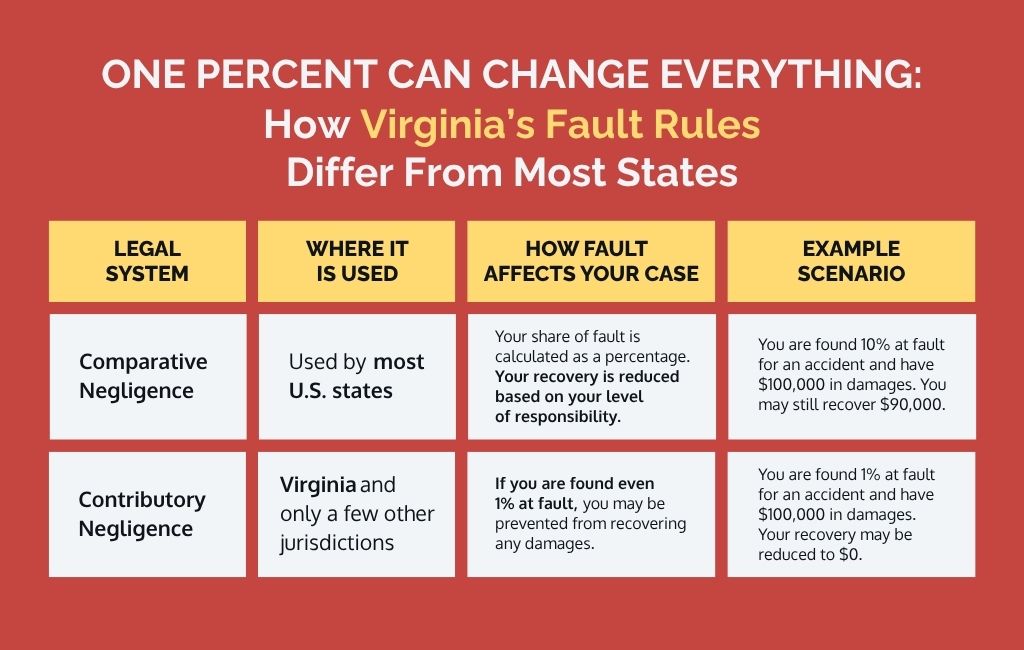
Virginia follows one of the strictest negligence rules in the country. If the person or insurance company defending the claim proves that you were even 1% responsible for the accident, you may be barred from recovering damages altogether.
It does not matter if the other party was 99% at fault. Even a small amount of fault on your part can prevent you from recovering compensation.
Because of this rule, insurance companies often look for ways to shift part of the blame onto the injured person. They may argue that you were speeding, distracted by your phone, failed to notice a hazard, ignored a warning sign, or could have reacted differently. Even if those claims are weak, raising them can become part of their strategy to avoid paying your claim.
Contributory Negligence vs. Comparative Negligence
Virginia is one of only a small number of states that still follow the strict rule of contributory negligence. In fact, only a few jurisdictions continue to use this system, including Alabama, Maryland, North Carolina, Virginia, and Washington, D.C. Most states have moved away from this approach and now use some form of comparative negligence instead.
Under contributory negligence in Virginia, a person who is considered 1% at fault could be treated the same as someone who is 50% at fault when it comes to recovering damages.
Comparative negligence works differently. In states that follow this system, an injured person can usually still recover damages even if they share some responsibility for the accident. The amount they receive is reduced based on their percentage of fault.
Why Does Virginia Still Use This System?
Virginia keeps this rule because it is deeply rooted in our historical common law. Unlike other states where lawmakers voted to change to a comparative system, Virginia’s General Assembly has repeatedly chosen to keep the traditional system.
While business and insurance groups argue that this rule keeps insurance costs lower and prevents unnecessary lawsuits, the reality is that it makes things incredibly difficult for honest people who have been hurt through no real fault of their own.
While these exceptions provide important protections in certain cases, they are not a replacement for proving fault. Since understanding how contributory negligence works in Virginia can be complicated, having a clear understanding of the evidence and legal arguments involved is critical when an insurance company claims you share responsibility for your injuries.
If you are facing a contributory negligence argument after an accident, our Virginia personal injury attorneys can help you understand how the law applies to your situation. Contact Smith Law Center at (757) 244-7000 or reach out online to discuss your case with our team.
Special Exceptions to the Contributory Negligence Rule in Virginia
Virginia’s contributory negligence rule is one of the strictest fault systems in the country. However, Virginia law does recognize a few narrow exceptions where an injured person may still have a claim despite some level of fault.
These exceptions are limited and depend heavily on the specific facts of the case. They are not automatic, but they can make a significant difference when the circumstances fit.
The Last Clear Chance Doctrine
The last clear chance doctrine is one of the most important exceptions to contributory negligence in Virginia. It may apply when an injured person was placed in a dangerous situation because of their own actions, but the other party had the final opportunity to avoid the accident and failed to do so.
For example, imagine a pedestrian accidentally steps into a roadway and becomes stuck in the path of an approaching vehicle. If the driver sees the pedestrian, has enough time to stop, but continues forward and causes a crash, the driver may be held responsible because they had the last clear chance to prevent the injury.
Common Carrier Safety Violations
Certain transportation companies, known as common carriers, have a higher duty to keep passengers safe. This includes services such as buses, trains, and other forms of public transportation.
In some situations, if a common carrier violates a safety law or regulation and that violation contributes to a passenger’s injury, the company may not be able to rely on contributory negligence as a complete defense.
Because these cases often involve specific safety rules and regulations, determining whether this exception applies requires a close review of the facts.
Willful and Wanton Conduct
Contributory negligence generally applies to ordinary negligence cases, but it may not protect someone whose actions show a reckless disregard for the safety of others.
This type of conduct goes beyond a simple mistake or moment of carelessness. For example, a driver who chooses to operate a vehicle while extremely intoxicated and causes a serious crash may have engaged in behavior that rises to the level of willful and wanton conduct.
The Rescue Doctrine
Virginia also recognizes the rescue doctrine in certain situations. This exception can apply when someone is injured while attempting to rescue another person from an immediate danger.
The law generally recognizes that people may act quickly and instinctively when trying to prevent serious harm. A person who takes reasonable action to save someone else may not automatically lose the ability to pursue a claim simply because their actions involved some risk.
However, like the other exceptions, the rescue doctrine is narrowly applied. The details of what happened, why the person acted, and whether their actions were reasonable all matter.
How Our Lawyers Prove Fault and Protect Your Claim
When the law is this strict, you cannot afford to handle an insurance claim alone. The insurance adjuster is not your friend, and they are actively looking for statements or details they can use to assign you that devastating 1% of fault.
To protect you from being unfairly blamed, we take immediate action to build a strong case:
- We secure black box data from vehicles, GPS logs, and nearby security camera footage.
- We track down witness statements that can provide valuable support when there is a dispute about who was responsible.
- We collect photos, accident scene evidence, and official records.
- We work with professional accident reconstruction experts to prove exactly how the crash happened. When necessary, we use specialists who can analyze evidence and explain the facts behind a collision.
- We work with medical professionals and other experts when needed to connect your injuries to the accident and explain the full impact of what occurred.
- We handle all communication with the insurance companies so you do not accidentally say something they can twist into an admission of fault.
Don’t Let 1% Fault Cost You Your Entire Case
In Virginia, one small mistake can have a major impact on your ability to recover after an injury. That is why proving the facts, challenging unfair blame, and building a strong case from the beginning matter so much.
For 75 years, Smith Law Center has helped injured people across Virginia take on difficult claims against powerful insurance companies. With over $1 billion recovered, a team with more than 300 years of combined experience, and a history of record-setting results, our attorneys know how to handle the high stakes of contributory negligence cases.
You do not pay attorney’s fees unless we successfully recover for you. Call (757) 244-7000 or contact Smith Law Center online today to schedule a free consultation and learn how we can help protect your claim.
Proudly Representing Virginia Residents
About Smith Law Center